
Identify Who Owns a Hamilton County Property
Ownership in Hamilton County is a cross-check, not a single-name web result. Start with the Hamilton County Appraiser. That office's roll links each tract to an owner name and assessment record. From there, the Register of Deeds lets you inspect the most recent conveyance. You can see who actually received the interest. Neither office advertises a verified public Kansas search screen. So call, visit, mail a focused request. Or use the county's KORA contact when that fits.
- Give the Appraiser the situs address, parcel number, or full legal description and request the current parcel card.
- Record the owner name, mailing address, valuation date, parcel key, and any deed reference exactly as supplied.
- Ask the Register of Deeds for the newest deed matching the legal description and compare its grantee with the roll.
- If the grantee is a company, search its exact legal name in the Kansas Business Entity Search.
Hamilton County Ownership Starts Offline
Hamilton County keeps its ownership records offline, in effect. The official county navigation offers no owner-name, address, or parcel search. A similarly named property portal actually returns Ohio land-use and school-district fields. It must not be used for Hamilton County, Kansas. That gap does not make the roll private. It just means one thing. The Appraiser's phone, mail, email, and counter service are the confirmed channels for Hamilton County property records. The official Appraiser page is the safe place to verify the office. Check it before you request an ownership record.
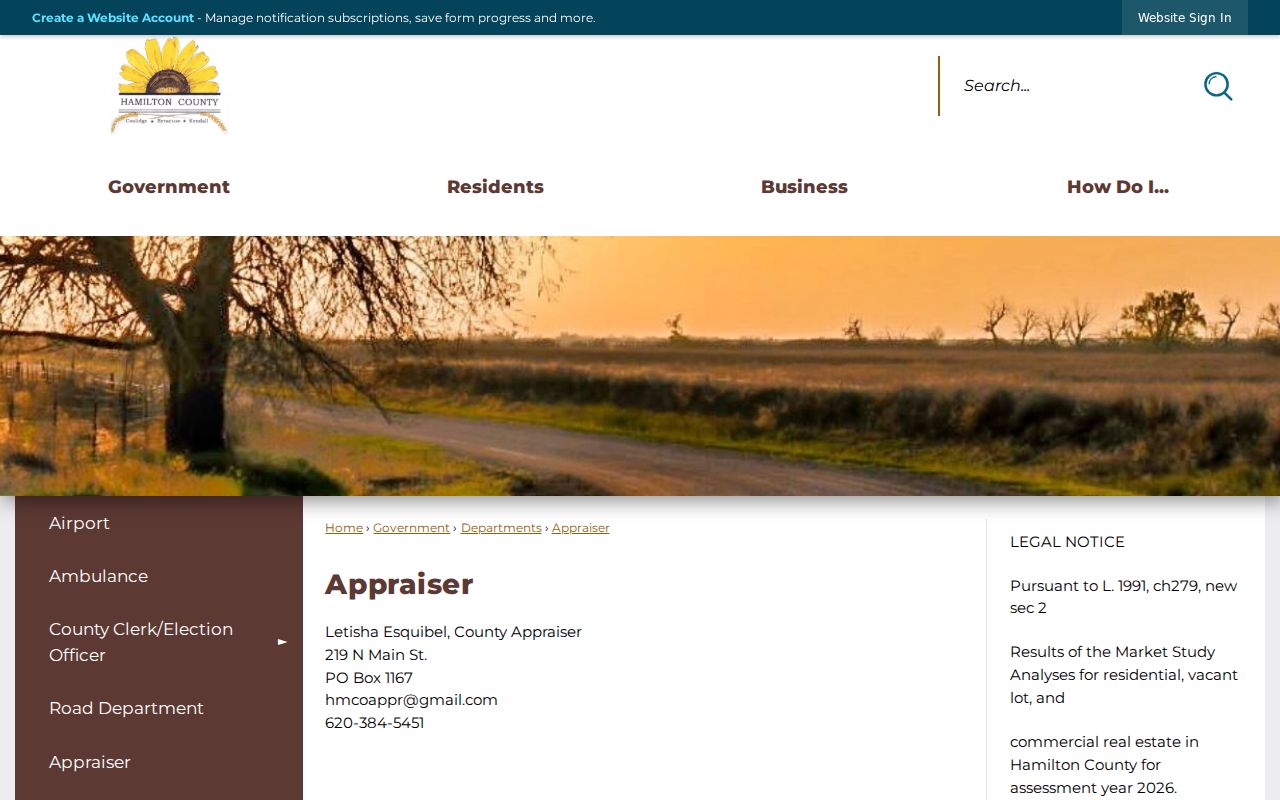
The county page names the local custodian and steers you away from the misleading out-of-state database. When you reach out, ask for an existing parcel card or roll entry. Staff should not be asked to decide ownership. Include the Kansas county, the property address, the legal description if known, and the date for which ownership matters. For a written public-record request, the County Clerk and Freedom of Information contact can explain the local KORA procedure. Copy costs may reflect actual production costs, and advance payment may be required.
Separate Situs, Mailing, and Legal Clues
Three identifiers do different jobs. The situs address locates the property itself. The owner's mailing address is where assessment and tax correspondence goes, which may be a post-office box or an out-of-state address. The legal description identifies the land in the deed. A Syracuse postal address can cover a tract whose decisive key is a rural section, township, and range, while town parcels often use a named addition, lot, and block.
Lean on the legal description when two owners share a name, when an address changed, or when a rural tract lacks a dependable street number. The person receiving the mail does not necessarily live there. A mailing clue is fair game for a lawful property inquiry, but the appraisal roll never establishes occupancy.
Note: Preserve every punctuation mark and directional in a legal description before asking the deed office to confirm a grantee.
Where Hamilton County Ownership Information Lives
Each source answers a different piece of "who owns this property." The appraisal roll is the fastest route to the assessed owner, while the recorded deed supplies the grantee and the legal description behind the transfer. Business records clarify an entity name. Hamilton County offers no verified GIS owner layer, so a web map should not be treated as an available ownership channel within Hamilton County property records.
| Source | Owner Info It Gives | Access |
|---|---|---|
| Appraiser roll | Assessed owner, mailing and situs clues, parcel details | Office request; public web search unverified |
| Register of Deeds | Grantee, grantor, legal description, recording reference | Open office inspection, except protected record categories |
| Secretary of State | Business status, business ID, and resident-agent results | Official online entity search |
| County Clerk | KORA request coordination when an existing record needs to be identified | Counter, phone, or written request |
The owner of record can be an individual, multiple grantees, a trust, an estate, or an entity. It is not automatically the occupant, permit applicant, or the person paying a bill. An old directory name carries little weight. Confirm the newest deed instead of blending those roles.
Confirm the Latest Hamilton County Grantee
The Register of Deeds states that qualifying records are open to public inspection during regular business hours. Sales Validation Questionnaires and military discharges are exceptions. The office publishes no online grantor-grantee index, image service, cutoff year, or copy price. Contact the staff with the roll's owner name and legal description. Ask for the latest recorded deed affecting that tract.
Then compare the details. Check the grantee, the execution and recording dates, the legal description. Compare the book/page or instrument reference against the parcel card. A freshly recorded deed can be newer than the annual roll. Be careful in the other direction too. An instrument that mentions the parcel may be a mortgage or easement rather than a conveyance. For deed-copy mechanics, turn to the dedicated deed records page. Confirming the latest transfer is all the ownership method requires.
Read LLC, Trust, and Estate Owners Carefully
An LLC or corporate owner of record adds a step. Search the exact entity name through the Kansas Secretary of State. Options include name, business ID, or resident agent. A registered agent is a contact for the entity. The agent is not automatically the beneficial owner of the land. Trust records may show only a trustee. An estate or fiduciary name can signal that probate records are needed to explain a transfer.
Life estates, joint ownership, and transfer-on-death instruments also require the recorded document to understand the interest conveyed. Never shorten entity suffixes or drop "trustee," "executor," or similar capacity wording. Those terms distinguish the named grantee from a person acting for another legal owner. That matters when Hamilton County deed records name an entity.
When the Hamilton County Roll Lags a Sale
The county does not publish its roll-refresh schedule or a typical number of days between recording and appraisal updates. Its 2026 market-study notice describes values as of January 1, 2026 and notices mailed by March 1, but that valuation schedule does not establish real-time ownership updates. Avoid inventing a local lag period.
When the roll and deed disagree, compare dates and ask both offices whether a later transfer is pending in the appraisal system. For present ownership, the latest properly recorded conveyance is the stronger current clue, although complicated title still warrants professional examination.
No Hamilton County Fraud Alert Was Located
The Register of Deeds page and its sitemap list no county property-fraud alert signup. An unofficial service using the county name is not the county. Enroll nowhere until the Register itself confirms a program. Owners worried about an unexpected filing can call the Register directly, inspect the newest instruments recorded under their name or legal description, and ask whether a county notification service has launched.
If an alert ever becomes available, it would only notify. It would not block a recording or judge whether an instrument is valid. Preserve any suspicious document. Then verify it with the custodian and qualified legal help.
What “Who Owns This Property” Cannot Establish
A roll name or a grantee in the deed records establishes only who holds record title. It does not show occupancy. It does not resolve competing interests, surface every unrecorded claim, or amount to a title opinion. Some protected people rely on Kansas Safe at Home. It supplies substitute addresses and mail forwarding, so a public mailing address is not necessarily a physical residence. Use owner information only for legitimate property research, purchase diligence, estate work, boundary questions, or civic transparency.
- Owner of record
- The party named by the official roll or recorded conveyance.
- Grantee
- The party receiving the interest stated in a deed.
- Situs address
- The location of the parcel, distinct from the owner's mailing address.
- Title
- The legal ownership interests and encumbrances, which require more than a directory result.
Ownership is not a directory shortcut. A Hamilton County owner name is not proof of title or residence. Never use public information to stalk, harass, intimidate, or harm anyone.