
Reconstruct Hamilton County's Former-Owner Timeline
Build a working table first. Its newest row is the latest recorded deed. Each earlier row names the prior grantor, who then becomes the next grantee to hunt. The Hamilton County Register of Deeds keeps deeds and related instruments open for public inspection during regular business hours, with Sales Validation Questionnaires and military discharges excluded. No online index coverage date is posted.
| Source | Years It Covers | Where Held | What It Shows |
|---|---|---|---|
| Current and earlier deeds | Exact years not posted | Register of Deeds inspection and request | Grantor, grantee, deed type, legal description, reference |
| Counter indexes and deed books | Earliest surviving year not verified | Register vault; ask about microfilm | Earlier transfers beyond any digital system |
| Plats and plat books | Hamilton holdings not itemized | Register and possible KSHS custody | Townsite, addition, lot, block, streets, and recording date |
| Newspapers and clippings | Syracuse Journal from 1885; clippings 1886–1998 | Kansas Historical Society | Sale, probate, mortgage, and legal-notice leads |
Deeds come first. The legal chain lives in recorded instruments. Plats keep the same tract in view when names or addresses change, and newspapers only supply leads that official land or court records must later verify.
Hamilton County's Online Cutoff Is Not Posted
The county recorder page offers no public grantor-grantee search. It names no earliest indexed year. It states no imaging cutoff and describes no electronic image access. So avoid claiming that former owners can be traced online to any particular year. Call or write the Register instead. Ask about the earliest surviving direct and reverse indexes. Ask about the earliest deed book, microfilm coverage, and any transferred volumes. Office inspection is the practical route. Bring the current grantee, a date range, and the complete legal description. Staff can explain how names are alphabetized. They can also say whether books are separated by direct index or reverse index. Deed type or time period can matter too. Copy fees are not posted, so confirm the price and any advance payment before ordering.
No verified web starting year. Older Hamilton County owners may require counter indexes, deed books, microfilm, and archive work. Never invent an online cutoff.
Walk the Hamilton County Deed Chain Backward
A reverse chain begins with a known present conveyance rather than an old name. Keep a separate line for each transfer. Copy the parties exactly. Include initials, estate roles, trust capacities, and company suffixes, and confirm each instrument conveys the same land, since one person may have held several Hamilton County tracts.
- Obtain the newest deed and record its grantee, grantor, recording date, deed type, legal description, and book/page or instrument number.
- Take that grantor and search backward for the instrument where the same person or entity appeared as grantee.
- Compare the legal description, not merely the address or surname, and note splits, combinations, or replats.
- Repeat the prior grantor and legal-description pair until the chain reaches the desired era or a documented gap.
- Grantor and grantee
- The parties conveying and receiving the interest stated in an instrument.
- Chain of title
- The ordered sequence of transfers affecting the same land.
- Reverse index
- An index arranged to help locate instruments by the receiving party or another recorder-defined key.
- Warranty and quitclaim deeds
- Different conveyance forms whose legal effect must be read from the document, not inferred from the label alone.
Book 4, Page 528 Opens an 1887 Trail
The strongest Hamilton County deed-book lead involves Coolidge's Potter Opera House. A Kansas Historic Resources Inventory narrative cites a Farmers' Loan and Trust mortgage dated March 4, 1887. The cite is Book 4, Page 528. Request that exact reference. It can reveal the parties, the legal description, the mortgage terms, and any later release or satisfaction. Treat it as a lead. It is not a complete chain. Read the instrument, then search each named party and the same Walnut-and-Wheeler legal geography in earlier and later deed books, where company, railroad, and fiduciary name variants often surface.
Note: A mortgage names parties with interests in a transaction, but it is not automatically a deed conveying ownership.
Probate Can Interrupt a Clean Name Chain
A former owner may die with no conventional sale ever recorded next. Death changes the paper trail. Estates, fiduciary deeds, probate orders, life estates, and transfer-on-death instruments can move or explain an interest. Search name variants too. Try "estate of," executor, administrator, trustee, and heirs before giving up on a name. Probate implicates the Hamilton County District Court. The Kansas District Court Public Access Portal provides public case index and event information subject to Rule 22, though many documents require a request to the Hamilton County District Court clerk. Use the file to understand the event. Return to the recorded land instrument and continue the chain.
Syracuse Newspapers Supply Missing Owner Leads
Newspapers fill gaps that deed books leave. The Kansas Historical Society reports that the Syracuse Journal likely began June 12 or 13, 1885. Its 1885 issues are scattered, and its 1886 coverage is stronger. The society's newspaper database and Hamilton County clippings surface legal notices and sheriff sales. They also surface plats and name variants. Search a surname with words like "deed," "sale," "mortgage," "estate," "notice," "plat," "addition," and "tax." Newsprint is supporting evidence, never recorded title. Use the date and names as leads. Then request the corresponding deed, court file, or tax-sale record.
Continue the Hamilton County Trail at KSHS
County deeds and federal tract books differ. The KSHS land-record guide explains the split. Tract books document the first transfer from the United States and are organized by legal description, not landowner name, while later conveyances belong in county deed records. The State Archives catalog can identify record groups, microfilm, maps, and transferred material.
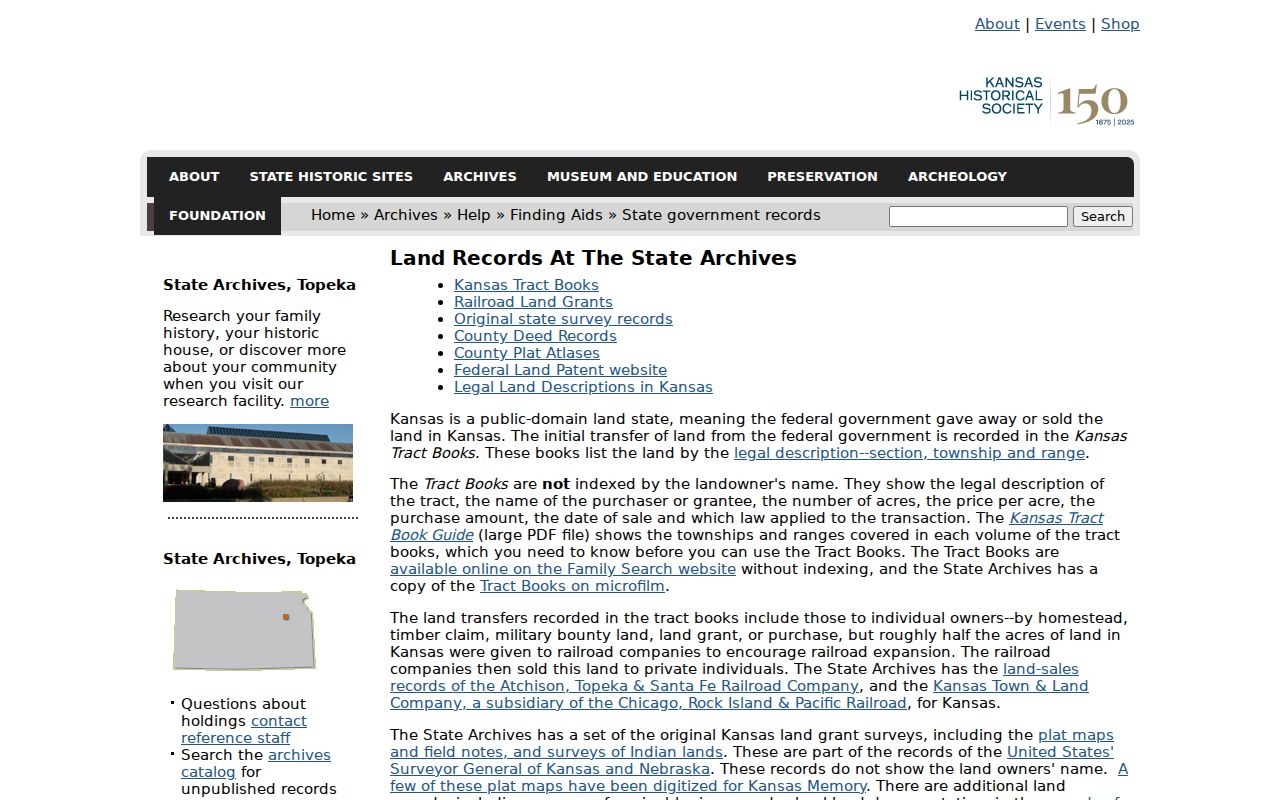
Ask the Register first about local custody. KSHS then needs the county, record series, date range, names, and a section-township-range or lot-and-block description. Log accession and reel numbers.
The County-Seat Dispute Explains Early Record Geography
Hamilton County organized in 1886. That same year began a county-seat contest between Syracuse and Kendall that ran into 1888. Accounts say officials resisted turning over records before Syracuse became the operative county seat. This explains a quirk. An early name or notice may sit in a community source. The modern custodian, though, is the Syracuse courthouse. Do not infer divided records or destroyed books. No courthouse fire, flood, or other record-loss event marks the county's history. Verify the first surviving deed and index volumes with the Register. Use period newspapers and KSHS histories only to frame the custody question.
How Far Back Hamilton County Ownership Can Go
Hamilton County organized in 1886. But that date alone proves nothing about its earliest deed book. The first county volume may not even survive. Before trusting any chain of title, ask whether the original indexes were reconstructed after a loss. Also ask whether any microfilm or early volumes now sit with a different custodian. For the very first federal disposition of a parcel, the tract books organized by section, township, and range are the place to search. Every later private transfer points back to the Register of Deeds chain instead.
Historic plats can carry a surprising amount of detail. They preserve additions, streets, alleys, approvals, and recording dates for Hamilton County subdivisions. Syracuse Sanborn maps from 1914, 1922, and 1935 add building context. They prove nothing about title, though. Expect detours along the way. Railroad changes, probate, foreclosure, replatting, annexation, and spelling changes each may demand a different bridge source in the property records.
Historic is not current. A former-owner chain supports house history and property diligence, but it does not prove present title. Never use it to track, harass, or harm a living person.