
Build a Hamilton Property Search
Start with the Hamilton County Appraiser. Kansas publishes no public search form for the county. So give staff the best address you have. Ask for the parcel number, the legal description, and the owner of record. Each is carried on the roll. The mailing address, situs address, value year, and any deed reference matter too. That parcel number becomes your working key for every later call. The legal description is just as valuable, since it links today's records to historic ones.
Keep each question with the office that can actually answer it. The order also builds checkpoints. It helps you spot a roll name, deed date, tax account, or address that refuses to line up.
- Give the Appraiser the situs, 911, rural route, or known legal description.
- Record the parcel number, formal roll name, mailing address, and full land description exactly.
- Ask the Register of Deeds for the latest deed naming that owner as grantee.
- Ask the Treasurer for the same parcel's bill, payment, and delinquency status.
- Request the plat, map, or permit record needed for a boundary or land-use question.
Hamilton Appraiser Fields to Request
The Hamilton County Appraiser page lists office contacts and a current market-study notice. It offers no owner, address, or parcel search form.
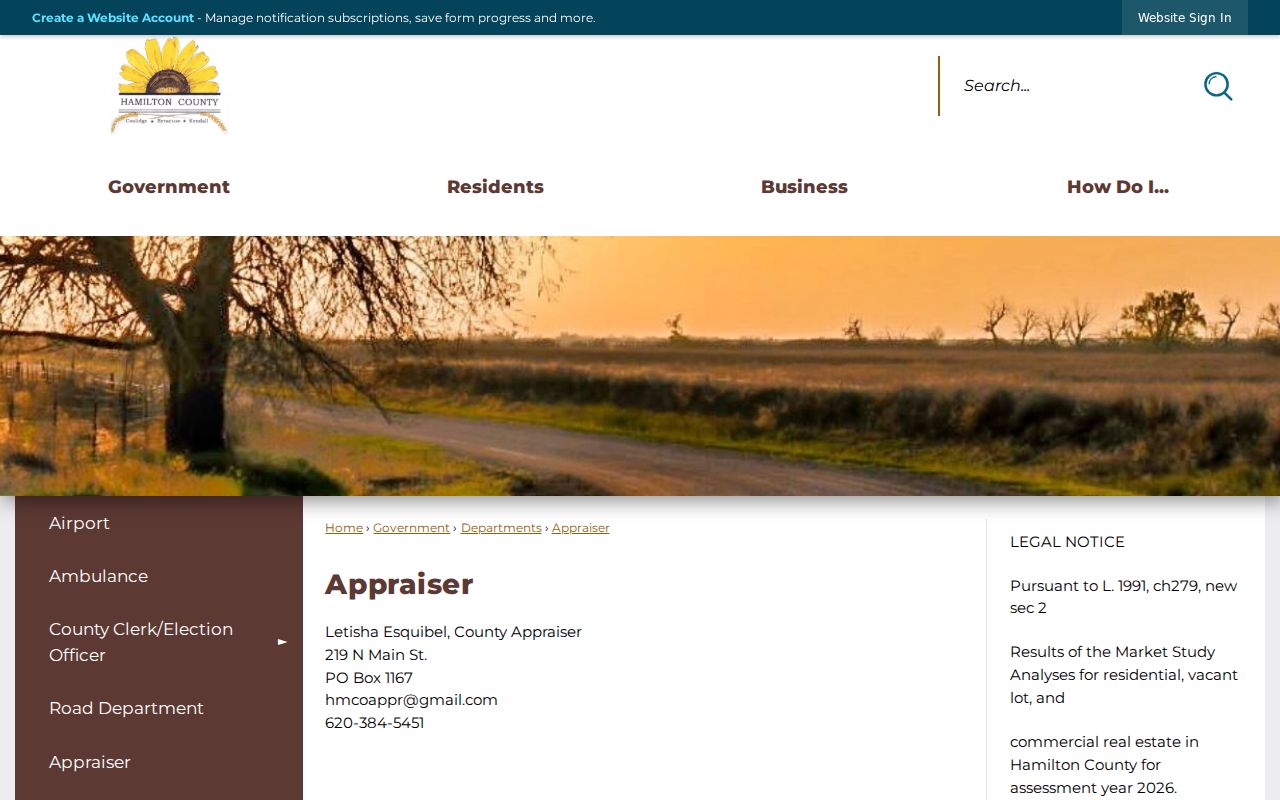
The office page confirms the Kansas custodian and the direct-request route. It does not reveal unpublished web fields. Local field labels, matching rules, coverage start, refresh schedule, and exports are not posted anywhere. Image access is not posted either. A careful Hamilton County property search should ask for fields. It should not assume they exist as online controls.
| Requested field | Why it matters | Local status |
|---|---|---|
| Owner name or organization | Bridges the roll to the deed index | Exact label not confirmed |
| Situs and mailing addresses | Separates the site from the notice address | Request both |
| Parcel identifier | Matches the assessed tract | Format not posted |
| Legal description | Tracks a lot or rural tract over time | Request full text |
| Value, class, exemption, year | Explains assessment context | Public screen not captured |
| Sale or deed reference | Points to the recorded instrument | Visibility not confirmed |
Use the spelling and punctuation the office provides. Skip any result that merely shares the Hamilton County name.
Avoid the Wrong Hamilton Portal
A similar-looking Hamilton property website exists. It serves up Ohio school districts, Ohio land-use codes, and Cincinnati-area appraisal fields. It belongs to another state. That confusion carries real cost. A polished result can pin the wrong owner, value, or land classification onto your search. Check the state and the county government domain. Check the office contact and the parcel geography before copying anything. The official Hamilton County pages point to the courthouse in Syracuse and the Kansas officeholders. When a portal cannot be traced back to those pages, skip it. Use the county office route instead.
Identity check. A valid Hamilton County property search must resolve to Kansas records, not a namesake county in another state.
Hamilton Address Keys Differ
Two different keys describe every tract. A situs address tells you where the land sits. A mailing address tells you where notices go. The two often differ because an owner uses a post-office box, lives out of state, or receives mail under a different postal city. Neither one proves occupancy or title. Rural Hamilton County adds another layer, since a route address, a 911 address, a postal city, and a section-township-range can all name the same tract. Inside Syracuse, the city zoning form bridges these systems by asking for lot, block, addition, 911 address, parcel dimensions, floodplain status, zoning, construction details, utilities, and a site plan.
- Situs address
- The location assigned to the property itself.
- Mailing address
- The destination for owner notices and tax mail.
- Parcel or APN
- An assessor identifier whose exact Hamilton format is not published.
- Legal description
- The deed and plat language defining the land.
What Hamilton Results Should Show
Hamilton County publishes no public parcel card online. Treat the fields below as a request checklist instead of a screen description. Ask the Appraiser for the current record. Ask staff which fields are public, current, and tied to the parcel.
| Roll name | Person, trust, estate, or entity carried for assessment |
|---|---|
| Situs and mailing | Physical site compared with notice destination |
| Parcel number | Exact county identifier for the assessed tract |
| Legal description | Lot, block, addition, section, township, range, or metes and bounds |
| Values and year | Appraised, assessed, taxable, use-value, or exemption data if released |
| Sale or deed reference | Date, consideration, book and page, or instrument link if present |
A result can lag behind a recent deed. It may omit an unrecorded transfer or show only an assessment name. Sketches, photos, map links, and sale histories are not confirmed web fields here, so ask rather than assume.
Confirm Hamilton Owners by Deed
The assessment roll is a strong current-owner clue. It is not the final title record. Ask the Register of Deeds for the newest recorded deed. It should name the roll owner as grantee. Compare the legal description, the recording date, and any book, page, or instrument reference.
The county publishes no online grantor-grantee index and states no cutoff year. Confirmed access runs through office inspection, telephone, email, mail, and a focused records request. Search name variants, initials, trustee wording, LLC suffixes, estate names, and married names. Two owners may share a name. Compare the land description and the mailing address before merging anything.
Note: A deed recorded after roll certification can be newer. It may postdate the appraisal record's owner name.
Hamilton Tax Search Is Unavailable
The Hamilton County Tax Search page states that the option is unavailable. An outside generic tax site is not a substitute for the county's own lookup. Call the Treasurer at 620-384-5522 or use the counter and mail channels for the current bill, payment status, prior-year balance, interest, and any delinquency. Payment methods are settled facts. The office takes cash, check or money order in person or by mail, and cards by phone or in person with a 2.5 percent fee. None of that means a remote property-search database is running. Include the parcel number and tax year in every request to avoid ambiguity.
Search Hamilton Land Descriptions
A street search in Hamilton County can dead-end fast. When it does, drop back to the legal description. Townsite property records usually cite a lot, block, and named addition for the county's old towns. Rural deeds instead use section, township, and range, or metes and bounds traced from a landmark. Addresses change. That stability makes the legal description the best bridge between the County Appraiser, the deed books, the plats, and Hamilton County's historical collections.
For the paper trail, the Kansas land-record guide separates federal tract books from county deeds. Tract books record only the first federal transfer. They are keyed by legal description, not landowner name. Later ownership means the Hamilton County grantor-grantee and deed-book trail, and for plats you can ask how the volumes are indexed and whether they remain at the courthouse, on microfilm, or at an archive.
Historic Hamilton Address Evidence
Hamilton County property search boxes struggle with old building names and vanished street grids. Syracuse Sanborn fire-insurance maps survive for 1914, 1922, and 1935. The Syracuse Journal probably began in June 1885. Issues that year are scattered. A fuller run began in 1886. Newspaper notices, city histories, and fire-insurance maps are often enough. You can pin down a person, business, block, or date. That detail anchors the next official request.
The Kansas State Archives catalog searches by keyword, title, creator, and identifier. Most holdings are not digitized. Treat every historical source as a lead. Then confirm the parcel or ownership point in a deed, plat, court order, or assessment record.
Search Hamilton Entities Carefully
Hamilton County land often hides behind an entity. A trust, estate, limited liability company, or railroad may hold the parcel. Search the formal name exactly as indexed. Then try initials, punctuation variants, business suffixes, trustee wording, predecessor entities, and fiduciary titles. Never assume the agent or manager owns the land.
The Kansas Business Entity Search can confirm a Kansas entity's name, status, business identification number, and resident agent. It caps results at 200 matches. It proves no title. Use the result only to refine the formal name; the deed and legal description decide whether that entity sits in the recorded property records trail.
Estate ownership may appear under the decedent, an executor, an administrator, or a later beneficiary. Probate events stay with Hamilton County District Court. Any resulting deed goes to the Register of Deeds.
Hamilton Zoning Address Cross-Check
Ownership answers only part of the question in Hamilton County. Land use and construction pull in a different office. Syracuse keeps planning, zoning, permit, and inspection work in separate routes. Its paper zoning permit asks for record and site facts alike. It wants lot, block, addition, 911 address, and parcel dimensions. Current zoning, floodplain status, and construction details follow. Utilities and a site plan complete the list.
That depth makes the Syracuse permit route a useful cross-check for property inside city limits. Outside Syracuse, County Zoning is the confirmed custodian. The same holds for Coolidge. Coolidge publishes no current city permit portal. A postal city proves nothing about jurisdiction. Confirm the boundary before you choose where to file.
Write a Focused Hamilton Request
The Kansas Open Records Act opens the door for anyone. You may inspect or copy releasable Hamilton County records. Send the request to the actual custodian, not just the County Clerk. Say Hamilton County, Kansas; name the appraisal, deed, tax, map, permit, or court record you need. Then supply the best matching keys.
A strong request lists an address, a full legal description or parcel number, formal party names, a date range, the document type, and the format you want. Ask to inspect first if several records could match. K.S.A. 45-219 permits actual-cost charges and advance payment. If expected staff time passes five hours or $200, the agency must contact you about ways to trim the cost. Always request an itemized estimate. Ask for a statutory citation for anything withheld.
Choose a Hamilton Search Key
Each key fits a different lock. Address, owner, parcel, and legal description each solve a separate matching problem in Hamilton County. The county exposes no confirmed web search controls, so the table below frames an office request rather than an online form.
| Search Key | Best For | Where It Works | Watch Out |
|---|---|---|---|
| Address | Identifying one known site | Appraiser or zoning request | Situs, mailing, rural route, and postal city differ |
| Owner name | Linking roll and recorded parties | Appraiser and Register of Deeds | Trusts, entities, estates, initials, and same names |
| Parcel number | Matching one assessed tract | Appraiser, Treasurer, mapping request | Exact local format is not posted |
| Legal description | Historic and rural continuity | Deeds, plats, Appraiser | Splits and replats can change the described tract |
Not a title search. A Hamilton County property search assembles public evidence. It cannot guarantee clear title, disclose every unrecorded interest, or replace legal review.