
Hamilton Tax Record Coverage
Every Hamilton County property tax record has two sides. The Appraiser's valuation side produces the numbers that feed the whole tax process. The Treasurer's collection side takes the certified tax roll and levies, applies them to the account, receives payments, and manages delinquency. Hamilton publishes no public parcel card or bill sample online. Request the actual county record instead of assuming any field labels you see described will match a web result.
| Field | What It Shows | Where |
|---|---|---|
| Appraised value | County estimate before the statutory assessment percentage | Appraiser |
| Assessed value | Tax-base value after applying the property-class rate | Appraiser and certified roll |
| Use class or exemption | Treatment that can change the taxable calculation | Appraiser |
| Tax statement | Amount billed, installments, and due dates | Treasurer |
| Payment and delinquency | Paid status, interest, correction, or sale milestone | Treasurer |
Recorded consideration belongs to the deed record, and it may not match current appraised value. Assessed value is the statutory tax base, not an estimate of what a property would sell for. The final bill depends on certified levies and how the account is treated.
Hamilton's 2026 Value Notice
The Hamilton County Appraiser notice says 2026 residential, vacant-lot, and commercial studies used valid arms-length sales from 2021 through October 2025. The market was fairly steady, with slight increases for some properties. An individual value can still change after physical changes, corrected property descriptions, or calibration to comparable sales.
Change-of-value notices mailed by March 1, 2026 state the appraised value as of January 1, 2026. They go to owners of record and are not tax bills. This distinction matters when comparing a spring notice with a later Treasurer statement.
Two different records. A Hamilton County change-of-value notice reports appraisal work. It does not show the final property tax bill or prove payment.
See Hamilton Tax Access Status
The county's own notice is the strongest sign that remote bill search cannot be promised. The Hamilton County Tax Search page displays its current unavailable status.
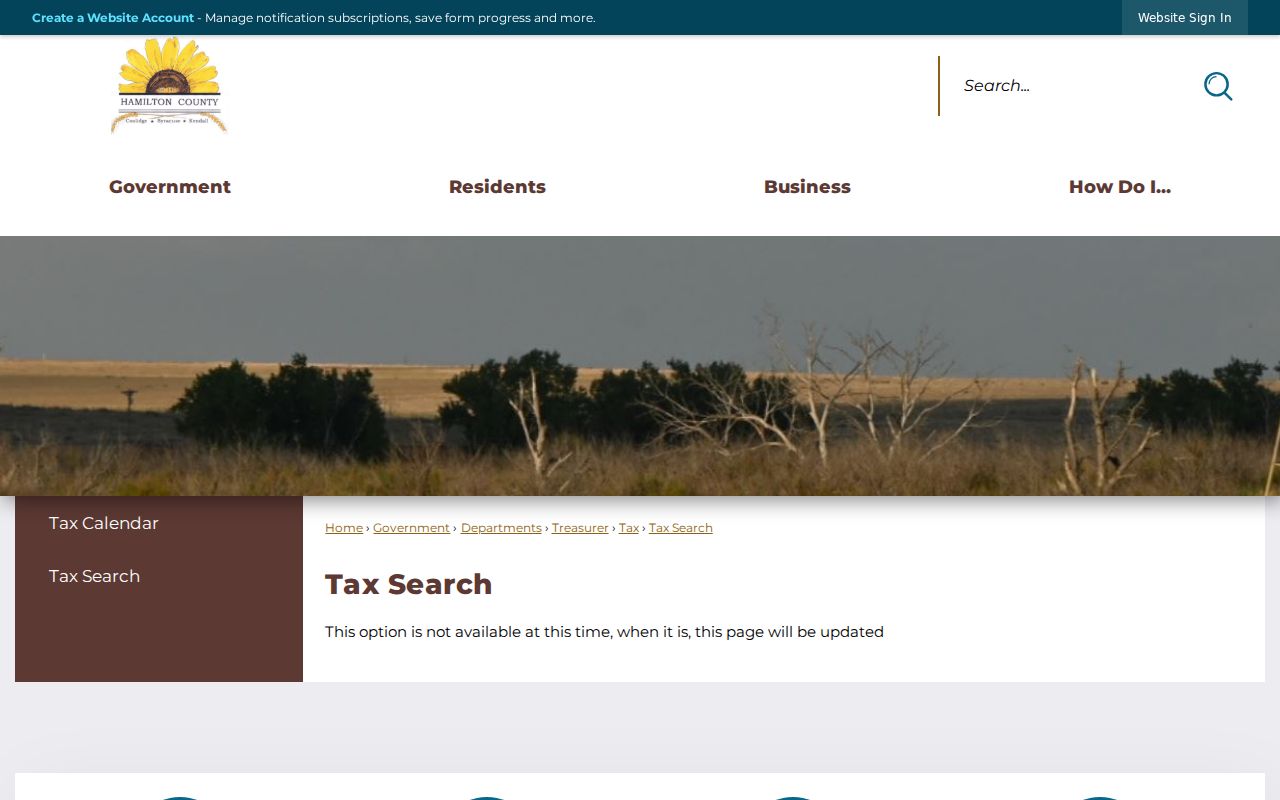
Until the county replaces that notice with a working search, use the Treasurer's phone, mail, and counter channels. Check the page again before relying on its status.
Kansas Assessment Rates in Hamilton
Kansas law sets assessment percentages by property class. Under K.S.A. 79-1439, residential real property is assessed at 11.5 percent of appraised value. Vacant lots are assessed at 12 percent. Commercial and industrial property is assessed at 25 percent. Agricultural land is assessed at 30 percent of agricultural-use value. Other statutory classes carry their own rates.
The state's own illustration uses a $100,000 residential appraised value. That yields an $11,500 assessed value before tax rates and account factors. That is a statewide example, not a Hamilton parcel value. Ask the Appraiser for the parcel's class, appraised value, assessed value, and taxable value. Also ask about exemptions and the effective year.
- Appraised value
- The county's value estimate under Kansas appraisal rules.
- Assessed value
- The class percentage of appraised or use value used in the tax base.
- Levy
- The rate applied to assessed value to fund taxing units.
- Tax lien
- A claim arising from unpaid property tax.
Hamilton Agricultural Use Value
Agricultural land skips ordinary open-market valuation. Kansas values it on income, productivity, and use. That use value is then assessed at 30 percent. A farm residence and its improvements can fall into categories apart from the land itself.
Hamilton County's 2026 notice reports slight decreases in dry and irrigated agricultural values. Some native-grass soil types increased. Agricultural land has been valued by soil type since 1998. This work falls under the annual use-value study in K.S.A. 79-1476. For a rural tax review, request the soil and use classification. Ask for the land component, improvements, residence, and current assessment year as separate items.
Request a Hamilton Tax Bill
The official Hamilton County Tax Search currently reports the option as unavailable. Reach Treasurer Alondra Leyva at 620-384-5522, mail the office at PO Box 1167, Syracuse, KS 67878, or visit the courthouse. Provide the parcel number, tax year, owner name as carried on the tax roll, and the property address or legal description.
- Ask the Appraiser for the exact parcel number and assessment year.
- Request the matching current statement and payment history from the Treasurer.
- Compare appraised, assessed, taxable, class, and exemption data with the bill.
- Ask whether interest, correction, foreclosure, or a tax-sale milestone affects the account.
- Statement
- The Treasurer's bill for a specific tax year.
- Payment status
- The office record of paid, partly paid, or unpaid amounts.
- Interest
- The additional amount that accrues under the county schedule after a deadline.
- Correction
- An authorized change to a tax account after an error or valuation adjustment.
Hamilton Property Tax Deadlines
The county tax page says statements usually mail in the first two weeks of November. Full payment or the first half is due December 20. From December 21 through May 10, the first half can still be paid with interest. After May 10, the full amount plus interest is due. Second-half reminders typically mail during the first two weeks of April.
Tax stays due even when no statement arrives. Keep proof of mailing or payment. Ask the Treasurer to confirm how it was applied. The courthouse drop box is designated for tax and antique-vehicle payments only.
Note: Use the current county calendar for the tax year at issue. Weekends, holidays, and later official updates can affect processing.
Hamilton Tax Payment Channels
The Treasurer takes cash in person. Checks and money orders are accepted in person or by mail. Cards are accepted in person or by phone, covering Visa, Mastercard, American Express, and Discover. These carry a stated 2.5 percent fee. Posted office hours run Monday through Friday, 7:30 a.m. to 4:00 p.m. Mountain Time.
Ask for the exact payoff amount once interest has begun. A prior statement may not reflect later interest, a correction, or another account change. Documentation is sometimes needed for a sale, estate, or accounting matter. In that case, request a receipt or payment confirmation.
Hamilton Delinquency and Tax Sale
Miss three years of real-estate taxes in Hamilton County. The property can then face foreclosure and public auction. The county Treasurer keeps the delinquency and sale-process facts. Related litigation files sit with the District Court, subject to Kansas public-access rules. A sheriff's deed or tax deed, once issued, is recorded with the Register of Deeds. Newspaper legal notices often point to a sale. Yet the official office record controls the true status. Before relying on any one figure, confirm the year, interest, notice stage, and redemption details. Check with the office that holds each record. Hamilton County publishes no single portal that consolidates all of these tax-sale records.
Hamilton Tax Corrections and Refunds
Mistakes happen. A corrected legal description can change a Hamilton County tax account. So can an exemption decision, classification, or valuation. Match the office to the problem. When the dispute involves property data or value, start with the Appraiser. Payment posting, statement delivery, interest, and refunds belong to the Treasurer. Keep the parcel number and tax year consistent across both contacts. The County Clerk handles budgets and tax levies but cannot substitute for either office. A focused KORA request can obtain releasable supporting records. Under K.S.A. 45-219, actual-cost and advance-payment rules may apply. Ask for an itemized estimate before requesting a broad file.
Compare Hamilton Tax Numbers
One Hamilton County property inquiry can surface four different numbers. Appraised value is the county's estimate under Kansas rules. Assessed value applies the statutory class percentage. A tax statement reflects assessed value, certified levies, exemptions, and account adjustments. Recorded consideration is a deed-related transaction figure when it is disclosed. None of these is automatically the price a willing buyer would pay today. Compare the valuation date, tax year, recording date, property class, and physical condition before drawing any conclusion. The 2026 county study window ends in October 2025. A later sale or property change may not show up in the spring notice. For a deeper value read, keep the assessment record separate from the payment record.
Appeal a Hamilton Assessment
Kansas gives property owners two main appeal paths. The Kansas Department of Revenue appeal route covers an equalization appeal after the spring Property Valuation Notice. It also covers payment under protest once taxes are paid. The state property-tax calendar sets the real-property equalization deadline at 30 days after the valuation notice is mailed.
An informal meeting with the Hamilton County appraiser generally happens by May 15. A determination then follows by May 20. A further Board of Tax Appeals route opens within the stated period after that informal decision. Confirm the current form and deadline with the Hamilton County Appraiser. Strong evidence helps. Bring the property description, photographs, and condition facts. Add comparable sales, classification details, agricultural soil or use data, and the date of any physical change.
Appeal window. File a Hamilton County equalization appeal within 30 days of the mailed valuation notice, and verify the exact receipt and form rules before the deadline.