
Hamilton Deed Types Explained
A deed names the parties, the land, and the interest the paper says moved. The Hamilton County Register of Deeds records qualifying instruments under Kansas law. The county page offers no local deed-type menu. Read the full instrument and its vesting language. Do not trust a short index label.
| Deed Type | What It Does | Common Use |
|---|---|---|
| Warranty deed | Conveys the stated interest with deed warranties | Ordinary arm's-length transfer |
| Quitclaim deed | Conveys whatever interest the grantor has, if any | Interest cleanup or related-party transfer |
| Executor or fiduciary deed | Conveys through an authorized estate representative | Probate or estate administration |
| Sheriff or tax deed | Records a transfer arising from a legal sale process | Foreclosure or tax sale |
| Mineral or oil and gas instrument | Addresses a stated subsurface right or lease | Agricultural and mineral title research |
Mortgages, liens, assignments, releases, and easements are encumbrances, not deed transfers. They still count. Each can burden, alter, or release an interest tied to the legal description, so search the whole recorded trail.
Hamilton Register of Deeds Access
The Hamilton County Register of Deeds is held by Register Pam Hook. Deputy Tova Barnes assists her. The office sits at 219 N Main Street, PO Box 1167, Syracuse, KS 67878. Call 620-384-6925 with questions. Posted hours run Monday through Friday, 7:30 a.m. to 4:00 p.m. Mountain Time. Records are open to public inspection during those hours. There are two exceptions: Sales Validation Questionnaires and military discharges stay closed.
The recording workload covers a wide range of instruments. Deeds and mortgages come through the office. Oil and gas leases arrive too, along with powers of attorney, easements, UCC filings, and daily transactions. No online grantor-grantee index or image viewer is available. The county publishes no coverage dates, exports, or subscriptions for its deed records. To search Hamilton County property records, plan on an office visit or a phone call. Email, mail, or a focused KORA request also work.
See Hamilton Deed Access
The county's official page confirms the rule. It also names the two restricted record categories. Review the Hamilton County Register of Deeds source before arranging an office search.
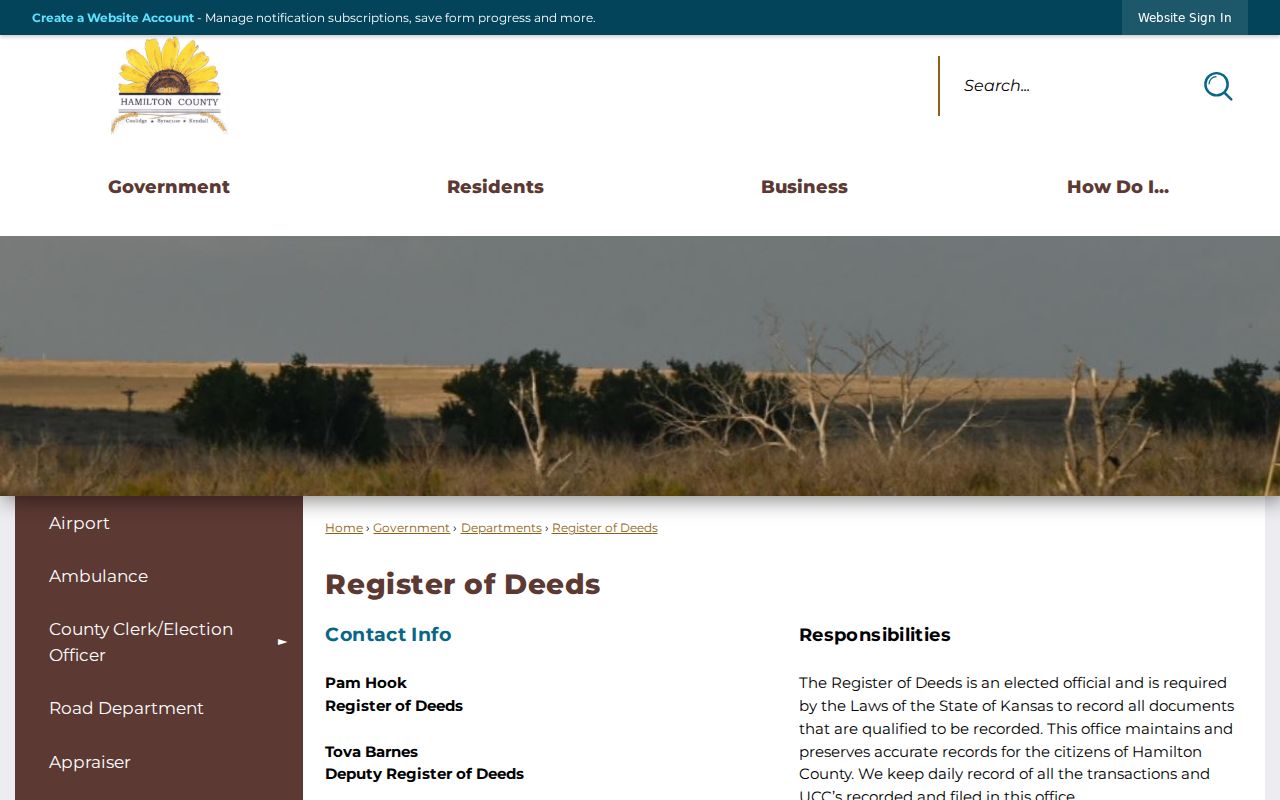
The page leans on office service details. It offers no public grantor-grantee search form or document-image link, which is why the counter route matters so much here.
Request Hamilton Deed Index Fields
No public search form exists for the index. Treat the field list as a request checklist. Give staff enough detail to separate parties and land, without assuming a local web interface supports every field.
| Index target | Use in the search | Hamilton status |
|---|---|---|
| Grantor | Seller or transferor, with initials and entity suffix | Request at office |
| Grantee | Buyer or recipient of the stated interest | Request at office |
| Document type | Separate deeds from liens, releases, easements, and plats | Web options not posted |
| Date range | Narrow a likely transfer period | Search control not posted |
| Book/page or instrument | Retrieve an exact recorded document | Local format not posted |
| Legal description | Keep the search on the same tract | Office and image route |
Ask about the older volumes. Learn whether they are alphabetical, tract-indexed, microfilmed, or digitized. The county does not state its first surviving or first online year.
Walk Hamilton's Grantor-Grantee Chain
Start a backward chain with the latest deed. Guesses about the first owner lead nowhere. The grantee receives the stated interest, the grantor transfers it, and each deed should supply the prior party plus a stable land description for the next search.
- Ask for the newest deed naming the current roll owner as grantee.
- Copy the grantor, legal description, recording date, and full reference.
- Search that grantor as a grantee in an earlier deed for the same land.
- Repeat until the index or surviving book sequence ends, then ask about earlier volumes and microfilm.
- Grantor
- The party transferring the stated interest.
- Grantee
- The party receiving the stated interest.
- Chain of title
- The ordered series of instruments affecting ownership.
- Book and page
- A volume and page reference used to retrieve a recorded filing.
Use Hamilton Legal Descriptions
Addresses change. The legal description holds steady. A Syracuse or Coolidge townsite parcel may be indexed by lot, block, and addition. Rural acreage may rest on section, township, range, or metes and bounds. Copy the text exactly, then match the same description across deeds, mortgages, releases, and plats.
Parcel splits break chains. Replats, railroad conveyances, and annexations do the same. So ask for both parent and resulting descriptions when acreage changed. A parcel number helps with the current roll. The exact Hamilton County format and its role in the deed index are not posted.
Coolidge Book 4 Deed Lead
The Potter Opera House in Coolidge offers a rare, exact bridge between local history and deed research. A Kansas Historic Resources Inventory narrative cites a Farmers' Loan and Trust mortgage dated March 4, 1887 in Hamilton County Register of Deeds Book 4, Page 528. The building stood at Walnut and Wheeler's southeast corner. Request that instrument by book and page. Then record the details. Log the parties, legal description, consideration if disclosed, mortgage terms, release, and later conveyances. The citation alone proves nothing about today's title. It shows how one known reference can unlock an offline deed-book trail.
Hamilton Deeds Beyond the Web
Hamilton County was organized in 1886. The county does not say whether that year matches its first surviving deed or index volume. It does not confirm the date of the earliest book either. The Kansas Historical Society land guide explains that county registers hold deeds made after the original federal transfer. Those registers begin after the federal transfer. KSHS microfilm coverage varies by county.
Ask the Register of Deeds about the earliest deed book, grantor and grantee index, plat book, microfilm run, and any transfer or loss notation. Ask about notations of loss or transfer too. The Kansas State Archives catalog and its reference staff can help identify holdings. Most archival records are not digitized. Federal tract books run on legal descriptions, not owner names. Bring section, township, and range for the first federal conveyance.
Note: Hamilton County history records no courthouse fire or destroyed-record event. So do not assume that a missing entry burned.
Hamilton Liens and Releases
The Register of Deeds handles more than warranty deeds. Mortgages, easements, assignments, and releases all pass through the office. When you trace an obligation, follow both ends of it. A loan that was paid off years ago can still appear open if the satisfaction was indexed under a variant name or a cross-reference you missed. A lis pendens filed with the court hints at property litigation, though the case file itself sits with the District Court, not the deed office.
For an efficient records request, gather the debtor or owner of record, an approximate date, the legal description, and the instrument type. Ask for linked assignments and releases together. Some obligations require a separate Kansas Secretary of State search, particularly where personal-property collateral or fixture questions complicate the parcel records.
Hamilton Probate Transfer Records
An owner's death can break a deed chain. Probate belongs to the Hamilton County District Court. It is not handled by the County Clerk or Register of Deeds. The Kansas district-court portal offers public index and event information under Rule 22. Once you locate the case, request the underlying probate order from the court clerk. The court can also provide the underlying file.
Recorded transfers return you to the deed office. Search the decedent's name, the estate name, and any fiduciary. Then follow the grantee who took title. A KDHE death certificate is restricted by law. It cannot substitute for the probate and deed trail anyway.
Hamilton County-Seat Record Story
Hamilton County dates its organization to 1886. Syracuse and Kendall fought over the county seat. The contest ended in 1888. That year the Kansas Supreme Court named Syracuse the lawful seat. Kansas Historical Society accounts recount rival officers. They also describe outright resistance to handing over the county records. That friction is worth remembering when you chase early filings.
Treat the story as a search clue, though. Modern Hamilton County property records are not split between two offices. For an early deed, ask which office and deed book were legally operative at the time. Ask whether the original volume survives. Ask whether a microfilm or archive copy exists. A notice in the 1885 or 1886 Syracuse Journal may name a party or a sale date. But the deed book remains the transaction record.
Order a Hamilton Deed Copy
A Hamilton County deed copy starts with a request to the Register of Deeds. Give the office the grantor and grantee names, the document type, and the recording date. A legal description helps, and any book, page, or instrument number speeds the search. Decide what you need from the record. You might inspect it, get a plain copy, or need a certified copy. The county page does not post exact copy and certification prices. The fees are statutory, so ask for the current amount and the accepted payment method before you send funds.
KORA allows agencies to charge actual cost for public-record copies. Advance payment is required, subject to exemptions. When several documents might match, inspection is the cheapest first step. Note: Sales Validation Questionnaires and military discharges fall outside the office's general open-inspection statement.
Recorded, not guaranteed. Hamilton County deed records show filed instruments. They do not guarantee clear title, resolve every interest, or replace a professional title examination.