
Start a Hamilton County Search
Hamilton County runs a courthouse-centered records system, so plan on direct contact. The County Appraiser comes first for a parcel number and current roll name. The same office supplies the situs address, legal description, and value details. Kansas offers no county-specific public search form in the official navigation. Phone, email, mail, and counter requests are the dependable route. Ask for exact fields rather than every file tied to an address.
Carry the parcel number, legal description, or formal owner of record name into the deed and tax searches. Those keys cut through confusion. Rural route changes, post-office city names, trusts, business entities, and split parcels can all blur an address-only lookup. Property records give strong leads. Still, a roll entry or deed index is not a title opinion. A plat or value notice is not a boundary survey either.
- Give the Appraiser the situs or 911 address and ask for the parcel number and legal description.
- Use the formal owner name and land description at the Register of Deeds.
- Ask the Treasurer for the current bill, payment status, and any delinquency.
- Request the related plat or parcel map from the Appraiser, Register of Deeds, or zoning staff.
- Inspect the record at the office or request the needed plain or certified copy.
Hamilton County Records Custodians
Three offices divide the core Hamilton County property records. The Register of Deeds records transfers and burdens on title. The Appraiser maintains property characteristics and values. The Treasurer collects real and personal property taxes and tracks bills, payments, interest, and delinquency. All three work from the Hamilton County Courthouse in Syracuse, which makes an office visit a primary access channel rather than a fallback.
Hamilton County Register of Deeds
219 N Main St, PO Box 1167
Syracuse, KS 67878
620-384-6925
Office inspection and copy requests
Hamilton County Appraiser
219 N Main St, PO Box 1167
Syracuse, KS 67878
620-384-5451
Property and value records
Hamilton County Treasurer
219 N Main St, PO Box 1167
Syracuse, KS 67878
620-384-5522
Tax office and payment details
Hamilton Deeds Stay Offline
The Register of Deeds page lists what the office records. That list includes deeds, mortgages, oil and gas leases, powers of attorney, easements, UCC filings, and other qualifying instruments. Hamilton County publishes no online grantor-grantee index or document viewer. Contact Pam Hook or Deputy Tova Barnes with a grantor, grantee, approximate date, land description, or a known book and page. The office holds public inspection Monday through Friday, 7:30 a.m. to 4:00 p.m. Mountain Time. The Sales Validation Questionnaire and military discharges are excluded from open inspection. Copy and certification charges are not posted, so request an itemized amount before ordering. Hamilton County deed research needs the recorded instrument itself. An owner name copied from a tax roll is not enough.
What Hamilton Puts Online
Hamilton County posts useful office pages, tax rules, calendars, and a current value notice. It publishes no Kansas deed search. A parcel-card search is missing too. Nor does the official navigation carry a county GIS map. One lookalike property portal shows Ohio school districts and land-use codes. That site is not a Hamilton County, Kansas source. The gap shapes the workflow. Use the office pages to find the right custodian, then call, write, email, or visit. The official Tax Search page itself says the option is unavailable. Under the Kansas Open Records Act, a focused request may ask for inspection or copies. Fees follow actual cost. Exemptions still apply.
Note: Confirm every search result names Hamilton County, Kansas first. Then trust its owner, parcel, school, or valuation fields.
Hamilton Property Search Keys
An address is often the easiest start, but Hamilton County land records rely on several keys. A situs address marks the physical site. A mailing address is where the owner receives notices, and it may be a post-office box or a different city entirely. A town lot may use lot, block, and addition. Rural acreage can require section, township, and range.
- Parcel number
- The county's administrative identifier for one assessed tract; the exact local format is not posted.
- Legal description
- The land description carried through deeds and plats, even when a street address changes.
- Grantor and grantee
- The party transferring an interest and the party receiving it.
- Plat
- A recorded drawing that lays out lots, blocks, streets, and related survey information.
Record punctuation and entity suffixes exactly. Trusts, estates, LLCs, married names, initials, and spelling variants can shift where a name lands in an index.
Hamilton County Record Types
Each Hamilton County property record answers a different question. Pairing records by parcel number or legal description is safer than expecting one office to show title, value, tax status, zoning, and boundaries together.
| Record Type | What It Documents | Kept By | Access |
|---|---|---|---|
| Deeds | Transfers, parties, legal description, recording reference | Register of Deeds | Office inspection or request |
| Mortgages and liens | Recorded burdens, releases, assignments, and notices | Register of Deeds | Office inspection or request |
| Assessment | Property traits, appraised and assessed values, use class | County Appraiser | Office request; no verified web form |
| Tax | Bill, payment, interest, delinquency, tax-sale status | County Treasurer | Phone, mail, or counter while web search is unavailable |
| Plats and zoning | Lots, blocks, additions, land use, permit clues | Recorder and city or county zoning | Recorded plat or office request |
A deed shows a recorded transfer. An assessment records a value for tax administration. The Treasurer's account shows payment and delinquency, not a market-price promise. A zoning permit can tie a 911 address to a lot, block, addition, parcel, floodplain finding, and site plan, but it does not prove ownership.
Hamilton Values for 2026
The 2026 Appraiser notice says residential, vacant-lot, and commercial market studies used valid arms-length sales from 2021 through October 2025. The market was fairly steady, with slight increases for some properties. Changes to a property, corrected descriptions, and calibration to comparable sales can still alter a specific value.
Notices mailed by March 1 state appraised value as of January 1, 2026. They are not tax bills. Kansas generally assesses residential real estate at 11.5 percent of appraised value, vacant lots at 12 percent, and commercial or industrial real estate at 25 percent under K.S.A. 79-1439. Agricultural land follows use-value rules and a 30 percent assessment rate. Hamilton County reports soil-type agricultural valuation since 1998.
View Hamilton Appraiser Evidence
Hamilton County's official Appraiser page lists the office's contact route and its current study. It offers no parcel search of its own. Still, the source page shown below is the right stop for verifying current notices and office details before you call.
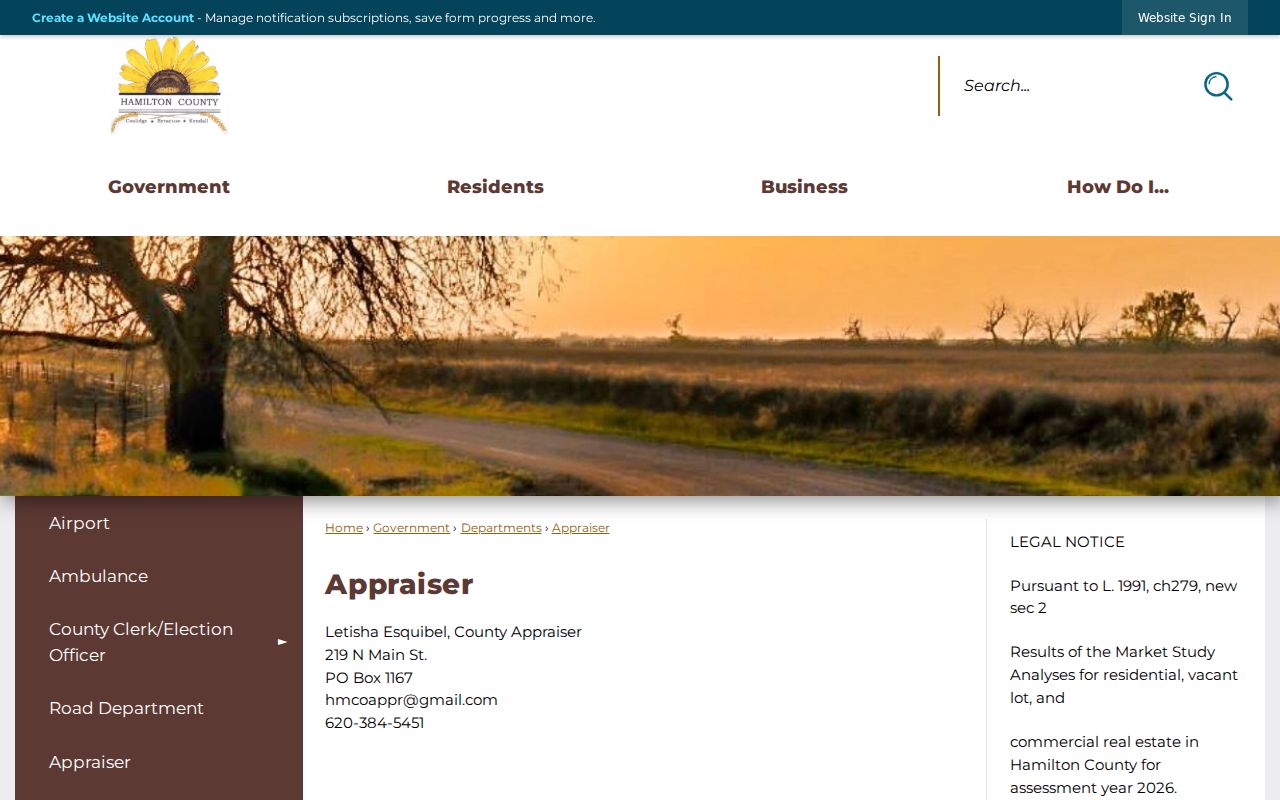
The image separates the real Kansas office from unrelated Hamilton County databases in other states. For any specific tract, request the underlying parcel record straight from the Appraiser.
Hamilton Tax Records Offline
The Treasurer posts a detailed tax schedule on the county site. There is no online account search. Statements typically mail in early November. A full payment or the first half comes due December 20. From December 21 through May 10, the first half carries interest. After May 10, the full amount plus interest applies.
Pay by cash at the office. Pay by check or money order in person or by mail. You can also pay by card over the phone or at the counter. Cards carry a 2.5 percent fee. Three unpaid years can trigger foreclosure. A tax sale and public auction may follow, under the county's own explanation. For a current balance, paid status, corrections, receipts, or sale milestones, ask the Treasurer.
Hamilton Maps Need Verification
Hamilton County publishes no parcel viewer and no open-data layer catalog. Federal and Kansas maps can help you orient a tract. They are no substitute for the county parcel record. Need a parcel number, legal description, plat, or any available map? Ask the Appraiser, the Register of Deeds, or County Zoning.
Town parcels usually turn on a lot, block, and addition. Rural property leans on section, township, and range, or metes and bounds. Kansas retention schedules describe permanent plats. These show streets, roads, alleys, subdivisions, annexations, surveyor details, approval, and recording date. That statewide description does not prove which Hamilton volumes survive on site. Confirm custody before you visit.
Reference lines only. A tax or GIS line is not a legal boundary. Use a licensed survey for a boundary decision.
Hamilton Records Began in Conflict
Hamilton County was established in 1873 and organized in 1886. Syracuse won the county seat after a contest with Kendall. The contest ran until the Kansas Supreme Court recognized Syracuse as the lawful seat in 1888. The Kansas Historical Society account describes rival claims in those years. It covers both officers and county records. Anyone tracing early filings should therefore confirm which office and volume held a record. That history does not mean modern records remain split between two seats.
The county posts no earliest surviving deed or index year. Ask for the first deed book. Ask for the first grantor and grantee index. Request any microfilm, and any transfer or loss note. Legal organization and the survival of a specific volume are separate facts.
Historic Hamilton Property Clues
Older Hamilton County property research can run through the Kansas State Archives. Its catalog searches by keyword, title, creator, and unique identifier. Most holdings are not digitized. The state land-record guide explains that federal tract books capture the first federal transfer. They are keyed by legal description. Later transfers belong in county deed records.
Newspapers and maps add context. The Syracuse Journal likely began in June 1885. Scattered issues survive from that year, with fuller coverage in 1886. Syracuse Sanborn maps survive for 1914, 1922, and 1935. They can reveal old uses, footprints, street context, sales notices, probate notices, and names. They cannot establish title. One concrete Coolidge lead is the Potter Opera House history. It cites a March 4, 1887 mortgage in Hamilton County Book 4, Page 528.
KORA Opens a Request Route
Where a portal is missing, the Kansas Open Records Act, K.S.A. 45-215 through 45-223, supplies a written-request framework. Send the request to the office that keeps the record. Name Hamilton County, Kansas. Include the record type, address, parcel or land description, names, and a narrow date range. When copy costs are uncertain, request inspection first.
K.S.A. 45-219 permits actual-cost fees, advance payment, and staff-time charges. If expected staff work exceeds five hours or $200, the agency must reasonably contact the requester about cutting cost. Ask for an itemized estimate and the cited exemption for anything withheld. The County Clerk fills a Freedom of Information role, but it is not the recorder, appraiser, treasurer, or probate clerk.
Hamilton Court Property Files
Foreclosure, quiet-title, probate, and other real-estate disputes sit with Hamilton County District Court. The statewide Kansas District Court Public Access Portal offers public case-index and event information. Access is subject to Kansas Supreme Court Rule 22. Remote access does not put every pleading, exhibit, order, or protected detail online.
Identify the matter with a party name, case number, filing period, and property description. Then request the underlying public file from District Court Clerk Griselda Sigala at 620-384-5159. A recorded judgment or lis pendens affects the land. So does a sheriff's deed or executor deed. For any such instrument, return to the Register of Deeds. Court events and recorded instruments are related, yet neither office replaces the other.
Hamilton Privacy Boundaries
Public access has boundaries. Sales Validation Questionnaires and military discharges stay outside the Register of Deeds' open inspection statement. The office keeps those papers closed. Kansas vital records sit behind K.S.A. 65-2422d, which limits copies to eligible applicants. A death certificate is no shortcut into a probate property file. For qualifying victims, Kansas Safe at Home supplies substitute addresses and mail forwarding. That keeps a real home address out of public view.
Limits of Hamilton Property Records
Hamilton County property records can answer a lot. They name the parties to a recorded deed. They identify the assessed tract. They also show tax activity, filed liens, legal descriptions, plats, and public court events. Gaps still exist. A freshly recorded deed may postdate the appraiser roll. The owner of record may turn out to be a trust or company. An unrecorded interest never reaches a public index at all. Protected documents stay restricted no matter who asks.
Lawful use. Use Hamilton County records for purchase research, estate work, boundary questions, tax review, and civic transparency. Never use owner information to stalk, harass, or harm anyone.